Leave a Message

Thank you for your message. We will be in touch with you shortly.

Inventory levels continue to climb modestly on a year-over-year basis, with new listings surging heading into the spring selling season.

Inventory levels continue to climb modestly on a year-over-year basis, with new listings surging heading into the spring selling season.

The Big Story
Quick Take:
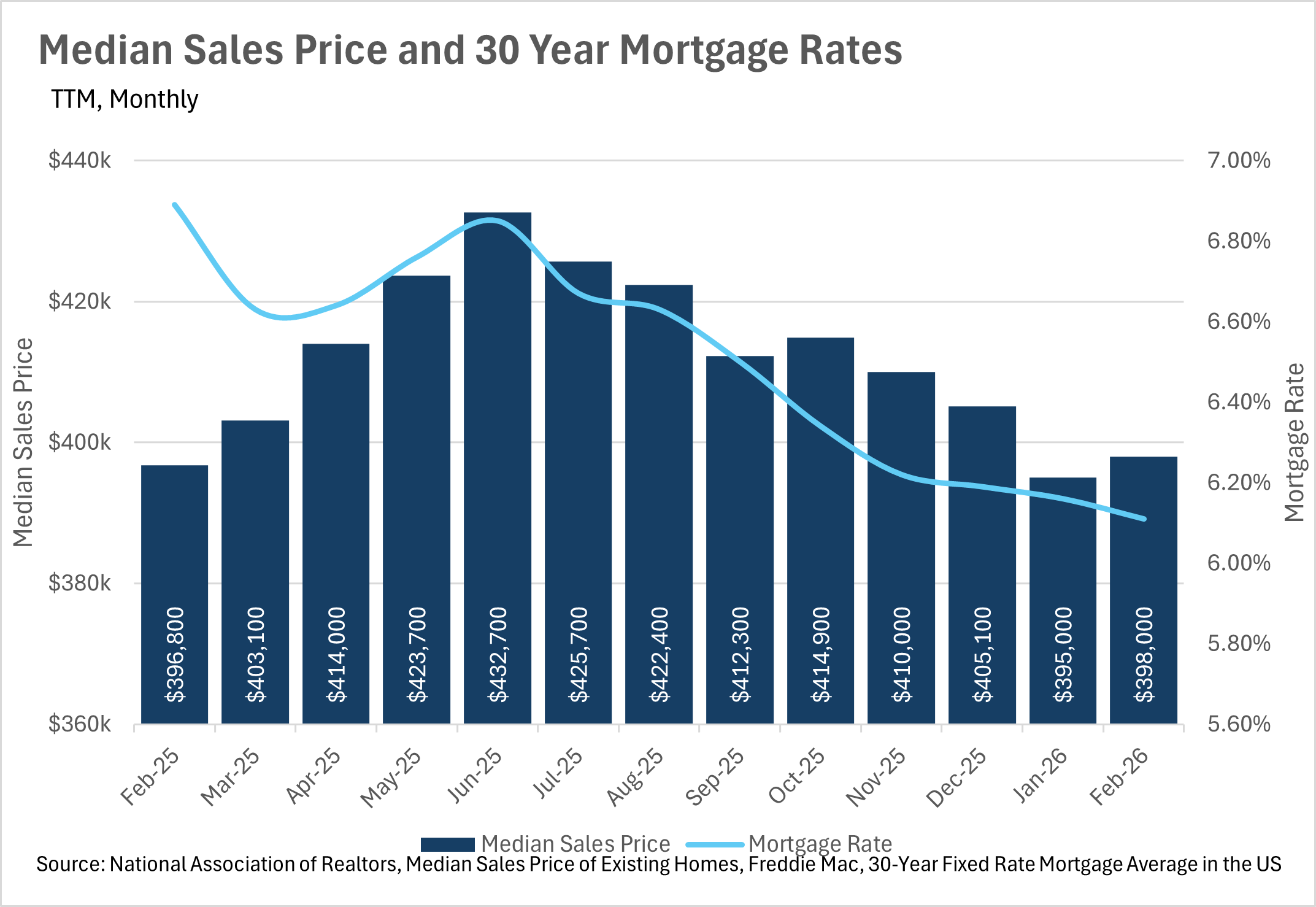
  • Median home sale prices ticked up slightly on both a month-over-month and year-over-year basis in February, continuing the holding pattern we've seen in recent months.
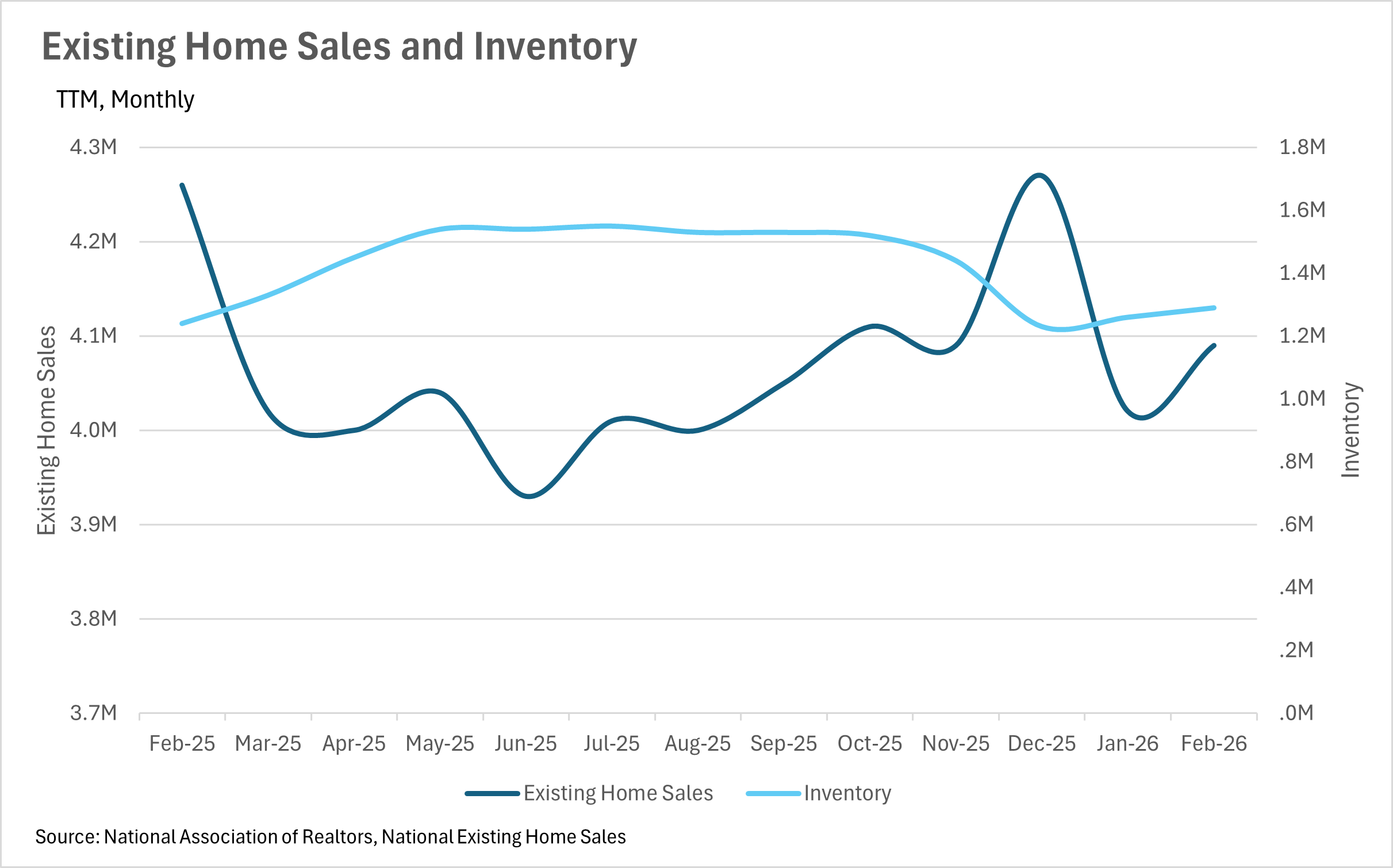
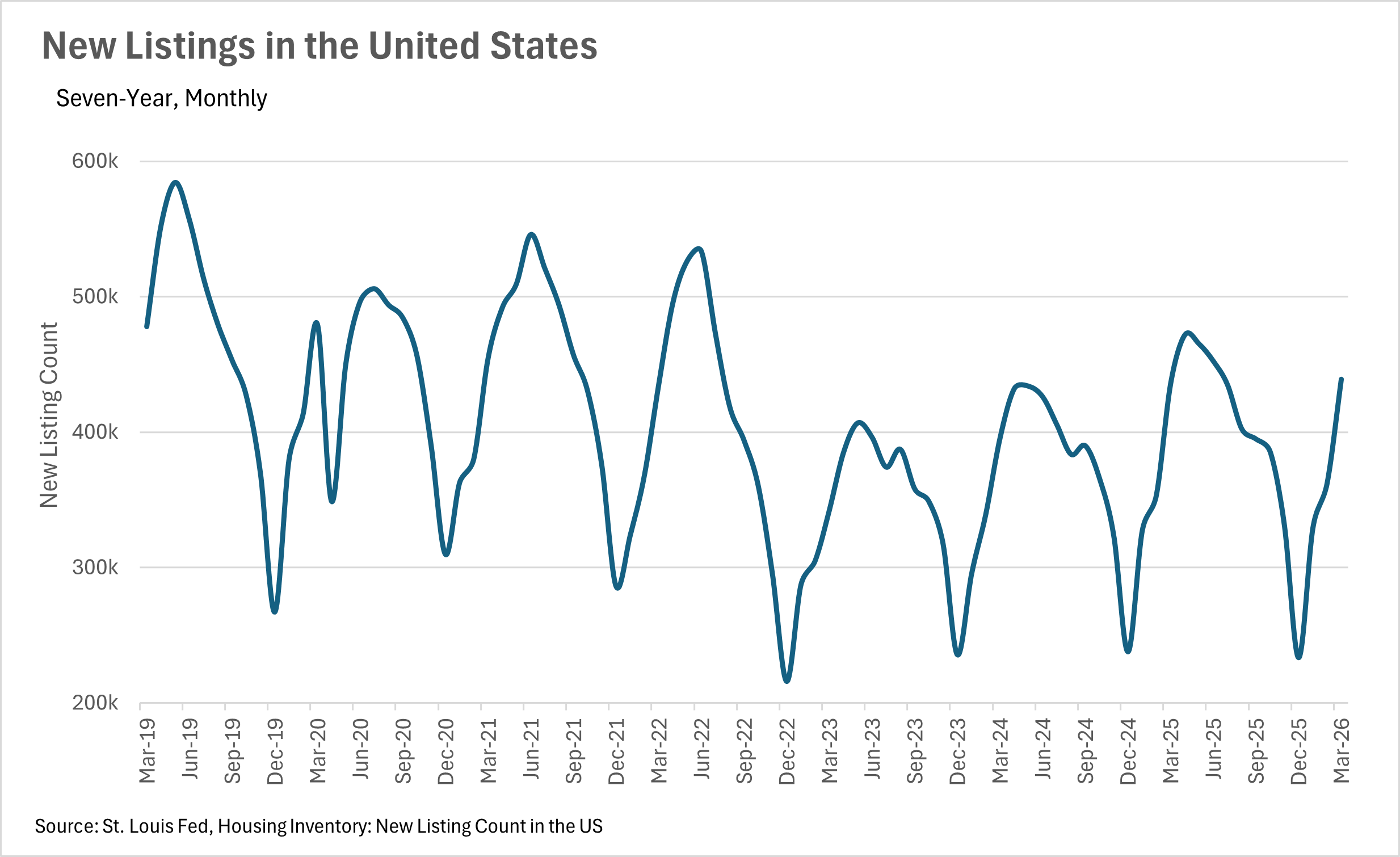
  • Inventory levels continue to climb modestly on a year-over-year basis, with new listings surging heading into the spring selling season.
  • Existing home sales rebounded slightly from January, but remain below where they were at this time last year.
Note: You can find the charts & graphs for the Big Story at the end of the following section.
*National Association of REALTORS® data is released two months behind, so we estimate the most recent month's data when possible and appropriate.
 
Falling rates continue to ease the affordability crunch
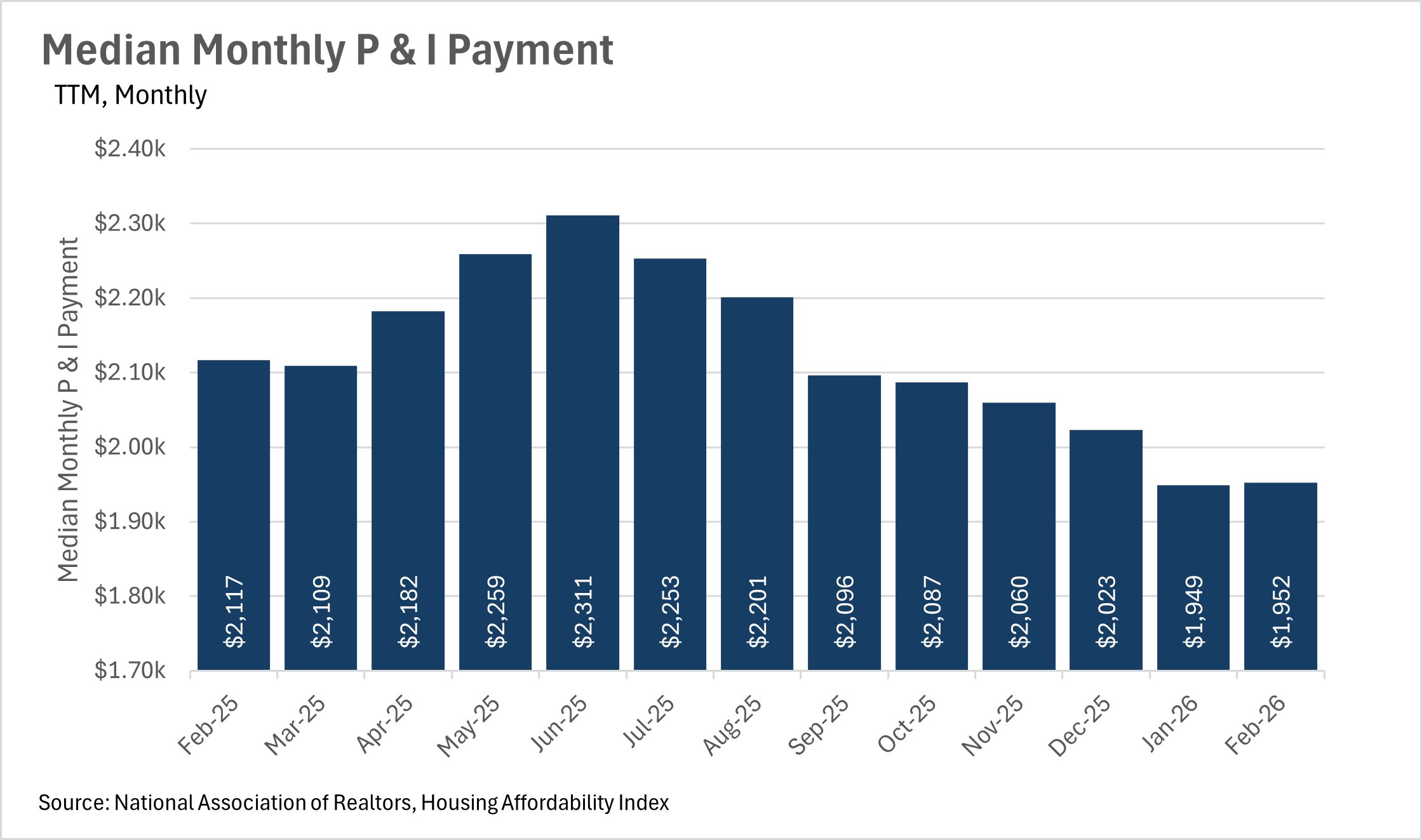
Although median home sale prices have remained remarkably stable over the past several months, the continued decline in mortgage rates is making homeownership considerably more affordable than it was just a year ago. In February, the median home sold for $398,000, representing a modest 0.30% year-over-year increase and a 0.76% uptick from January. On the mortgage rate front, the average 30-year rate dropped to 6.11% in February, representing an 11.32% year-over-year decline from the 6.89% we were seeing at this time last year. This decline in rates has had a major impact on what the average homeowner is paying each month. The median monthly P&I payment came in at $1,952 in February, down 7.79% from the $2,117 the median homeowner was paying just a year ago. That's approximately $165 in monthly savings, which is a significant boost to the average American's budget. If rates continue to trend downward, we could see buyers start to return to the market in a meaningful way as we move deeper into the spring and summer months.
New listings are surging as we head into the spring
One of the most encouraging stories in the housing market right now is the dramatic increase in new listings as we move into the spring selling season. In March, there were 439,000 new listings that hit the market, representing an eye-popping 21.21% month-over-month increase and a 0.70% year-over-year increase. This surge in new listings is a very welcome sight, as it means buyers will have considerably more options to choose from as the market heats up. On the inventory side, there were 1,290,000 homes available for sale in February, representing a 4.03% year-over-year increase and a 2.38% month-over-month increase. This gradual build in inventory, combined with the huge surge in new listings, should give buyers some breathing room as we head into the busier months of the year. That said, inventory levels still have a long way to go before they reach the levels we'd consider truly healthy, so it'll be worth keeping a close eye on whether this momentum carries through the spring.
Existing home sales are showing early signs of life
After a sluggish January, existing home sales rebounded slightly in February, with 4,090,000 homes changing hands. This represents a 1.74% month-over-month increase, but still comes in 3.99% below where we were this time last year. While it's certainly encouraging to see sales pick back up, the year-over-year decline tells us that buyers are still being cautious despite the substantial drop in mortgage rates that we've seen over the past year. Part of the story here may be that buyers are waiting to see even more rate cuts before they jump in, or they may be waiting for the influx of new listings to give them more options to choose from. Either way, it'll be fascinating to see whether the combination of lower rates, climbing inventory, and a fresh wave of new listings is enough to bring buyers off the sidelines in the coming months.
A market that's slowly tilting back toward balance
When determining whether a market is a buyers' market or a sellers' market, we look to the Months of Supply Inventory (MSI) metric. The state of California has historically averaged around three months of MSI, so any area with at or around three months of MSI is considered a balanced market. Any market that has lower than three months of MSI is considered a seller's market, whereas markets with more than three months of MSI are considered buyers' markets.
 
At the national level, we're seeing an interesting dynamic play out. Inventory is growing at a modest pace on a year-over-year basis, existing home sales are lagging slightly behind last year's figures, and new listings are surging into the market just as we head into the traditionally busy spring season. All of this suggests that the market is slowly tilting back toward a more balanced state, which would be welcome news for buyers who have been dealing with tight inventory for years. However, if mortgage rates continue to drop and buyers finally decide to come off the sidelines, we could just as easily see the market swing back in favor of sellers. As always, real estate is a highly localized asset, which is why you should check out what's going on in your local market below in the Local Lowdown!
Big Story Data
The Local Lowdown
Quick Take:
  • Median sale prices rebounded in Sonoma County with a 1.16% year-over-year gain, while Napa County continued to struggle with a 10.61% decline.
  • Inventory remains significantly constrained, with single-family home inventory down 41.16% and condo inventory down 31.06% on a year-over-year basis.
  • Listings are moving much faster than last month across all four counties, with days on market dropping sharply as the spring selling season heats up.
 
Note: You can find the charts/graphs for the Local Lowdown at the end of this section.
Spring brings a mixed bag for home prices
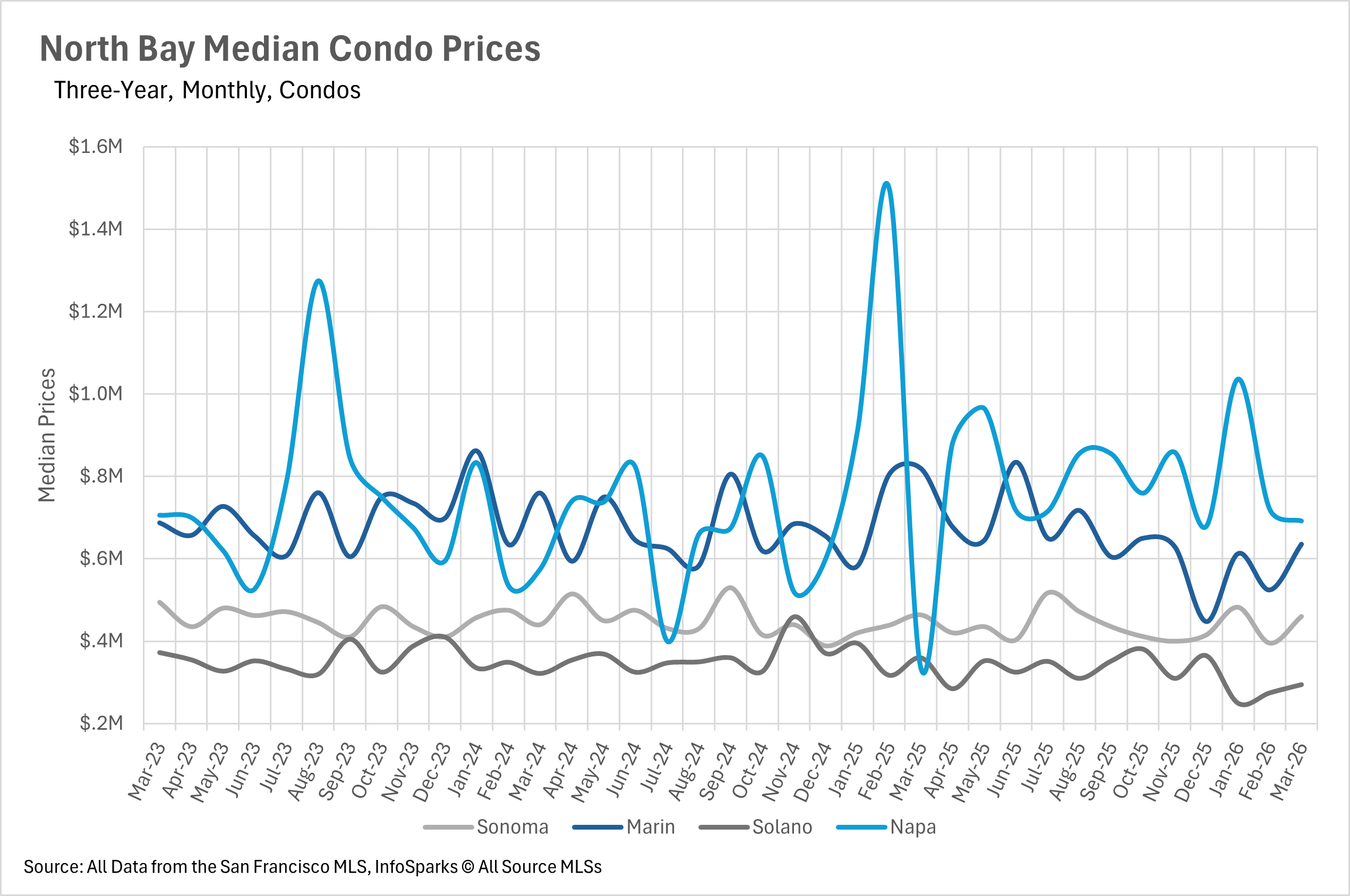
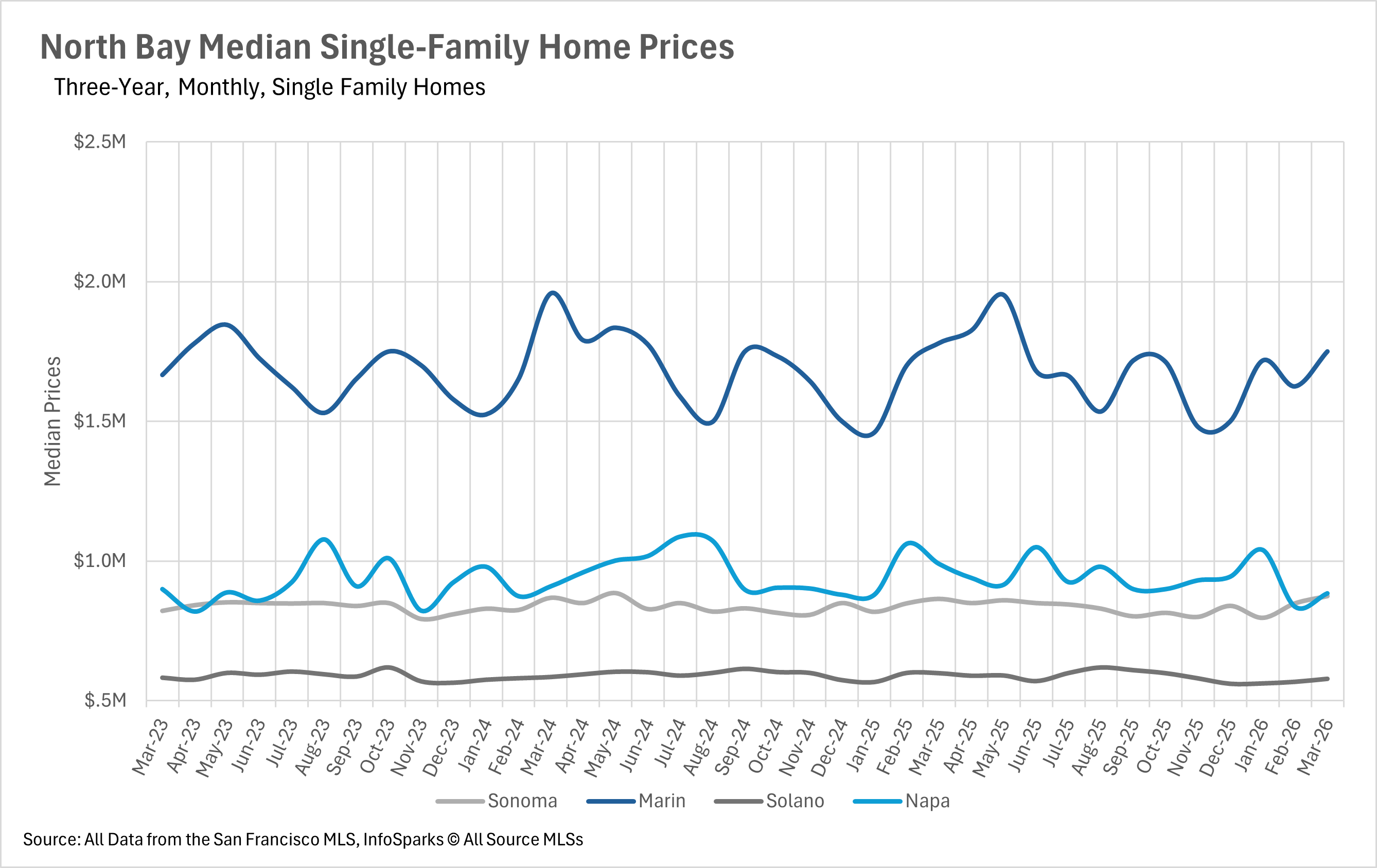
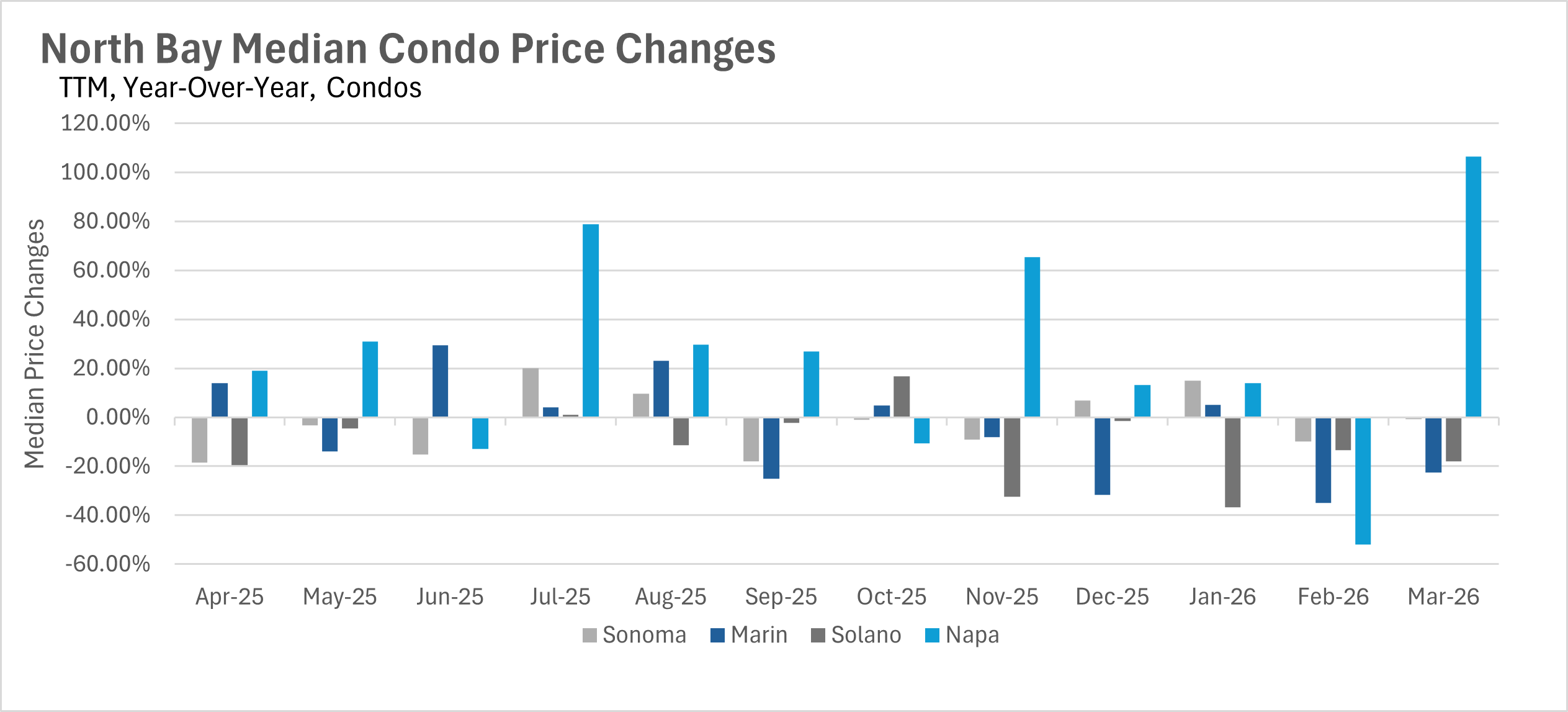
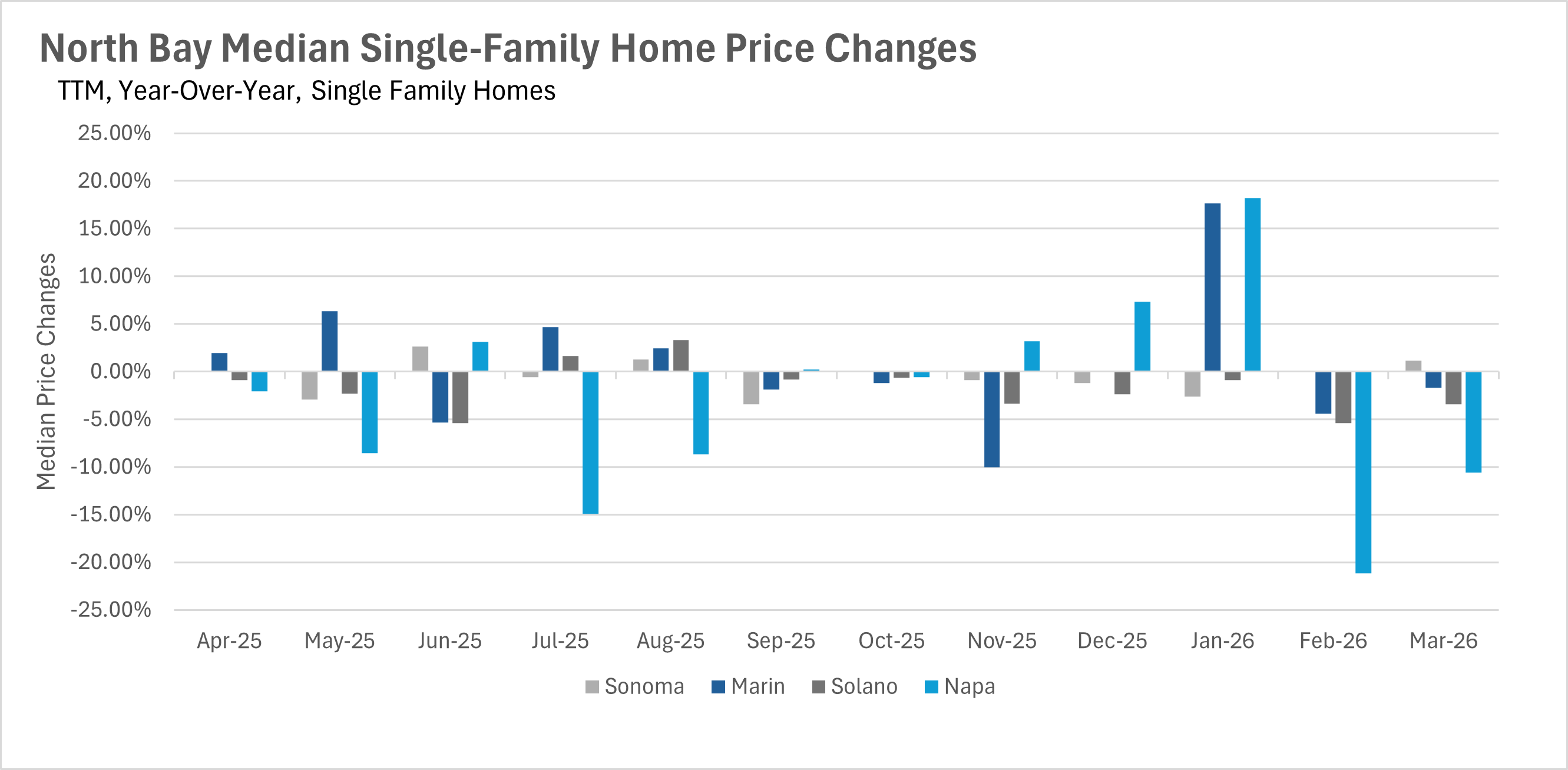
March delivered a tale of two markets across the North Bay's single-family home segment. Sonoma County saw a welcome rebound, with the median single-family home selling for $875,000, a 1.16% increase compared to March 2025. This marks a nice turnaround after several months of flat or declining prices. However, not all counties shared in the good news. Marin County saw a 1.69% decline to $1,750,000, Solano County dropped 3.45% to $578,320, and Napa County experienced a more significant 10.61% decline to $885,000. The condo market was characteristically volatile. Napa County condos saw a remarkable 106.50% year-over-year surge, though this is likely driven by a small number of high-value sales. Meanwhile, Marin County condos fell 22.50%, Solano County declined 18.06%, and Sonoma County dipped 0.81%.
Inventory remains in short supply as spring arrives
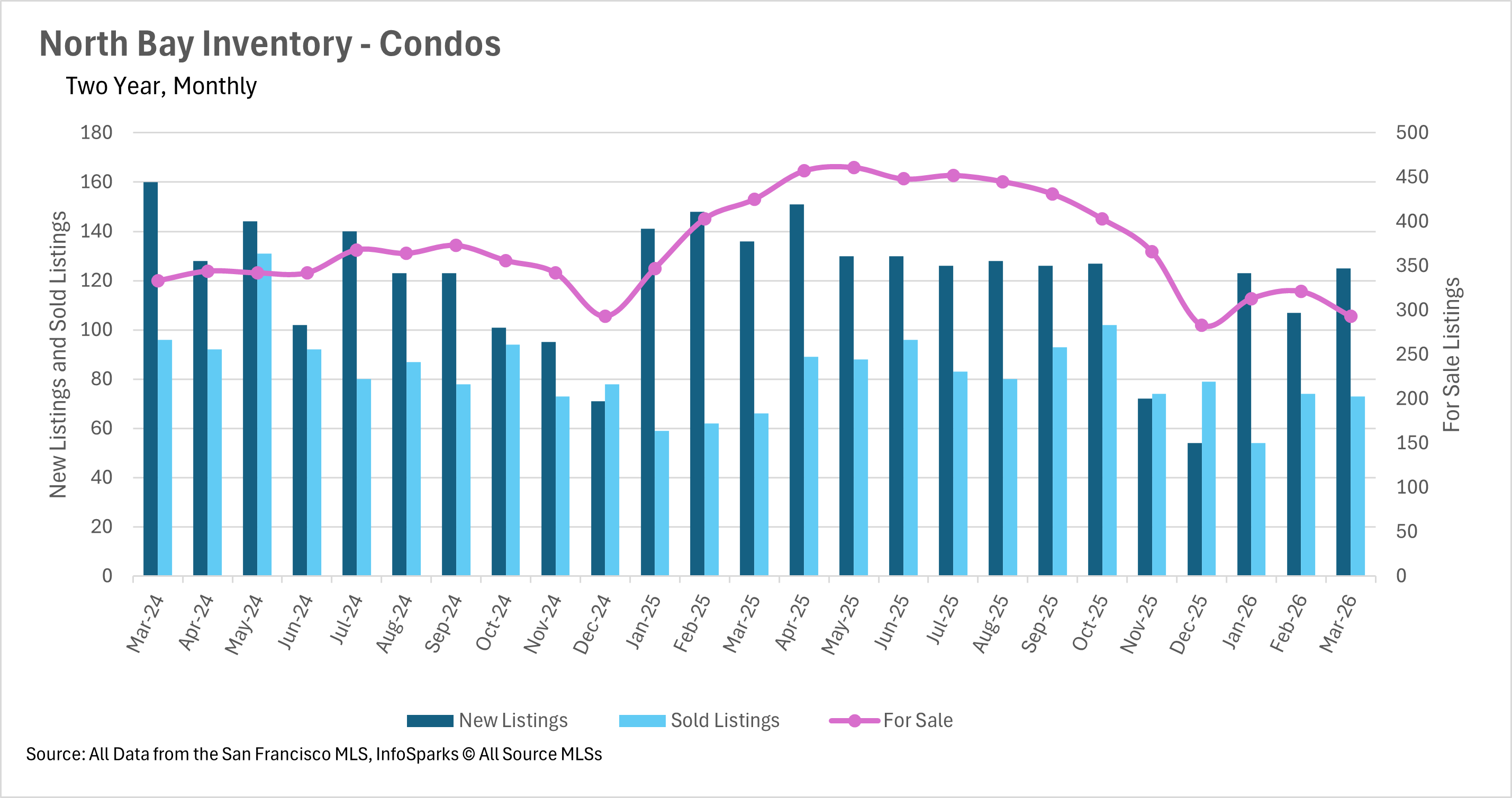
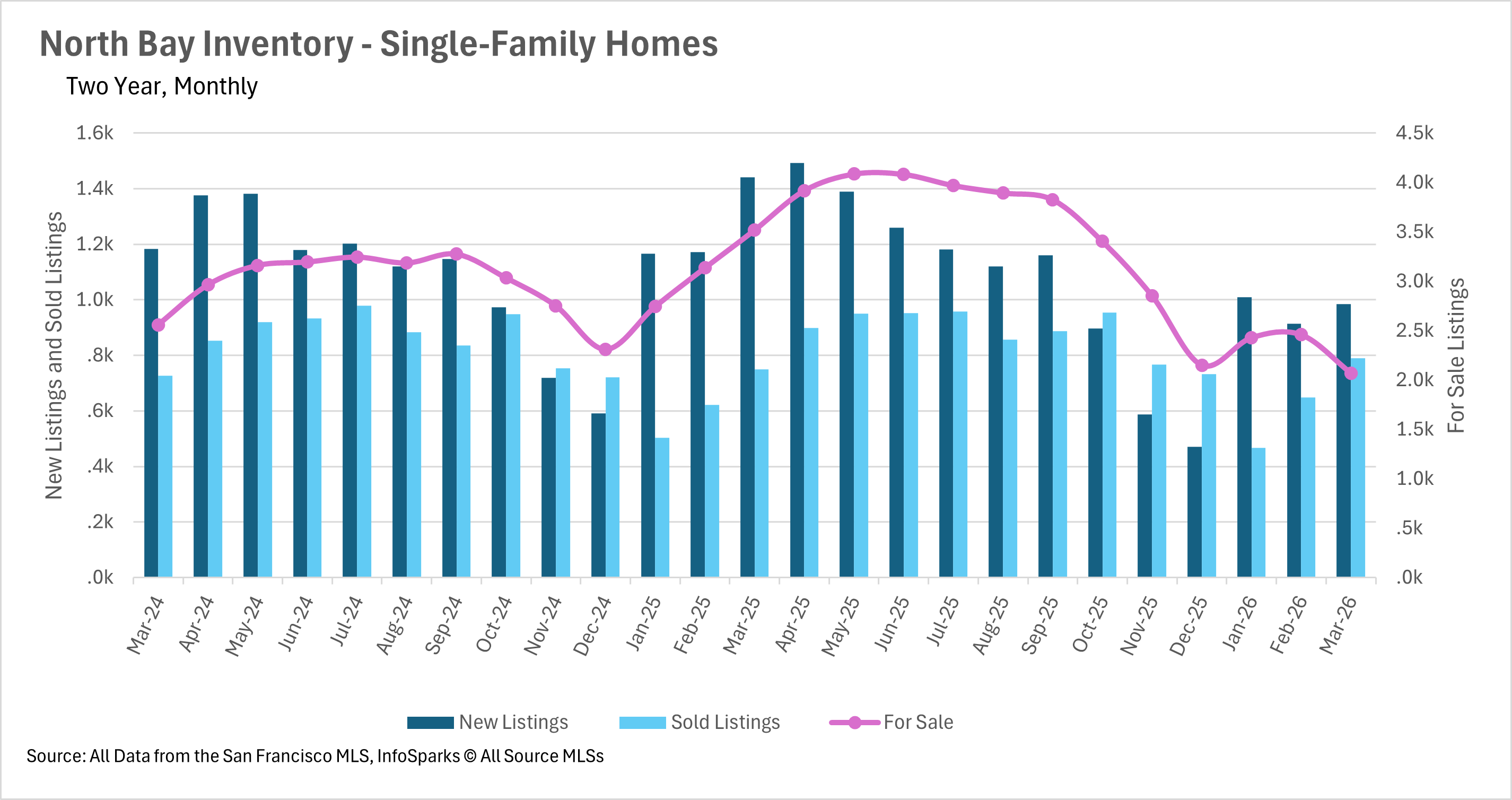
Despite the arrival of the spring selling season, inventory levels remain well below historical norms. Single-family home inventory across the North Bay now sits at 2,070 units, down 41.16% compared to March 2025. The condo market tells a similar story, with just 293 units available, a 31.06% year-over-year decline. The good news is that sales activity is picking up. Single-family home sales increased 5.33% year-over-year, and condo sales jumped 10.61%. New listings are also trending in the right direction, with single-family new listings up 7.77% month-over-month and condo new listings up 16.82%. However, new listings remain well below last year's pace, down 31.69% for single-family homes and 8.09% for condos. Until more sellers enter the market, buyers will continue to face stiff competition.
Homes are flying off the market as spring heats up
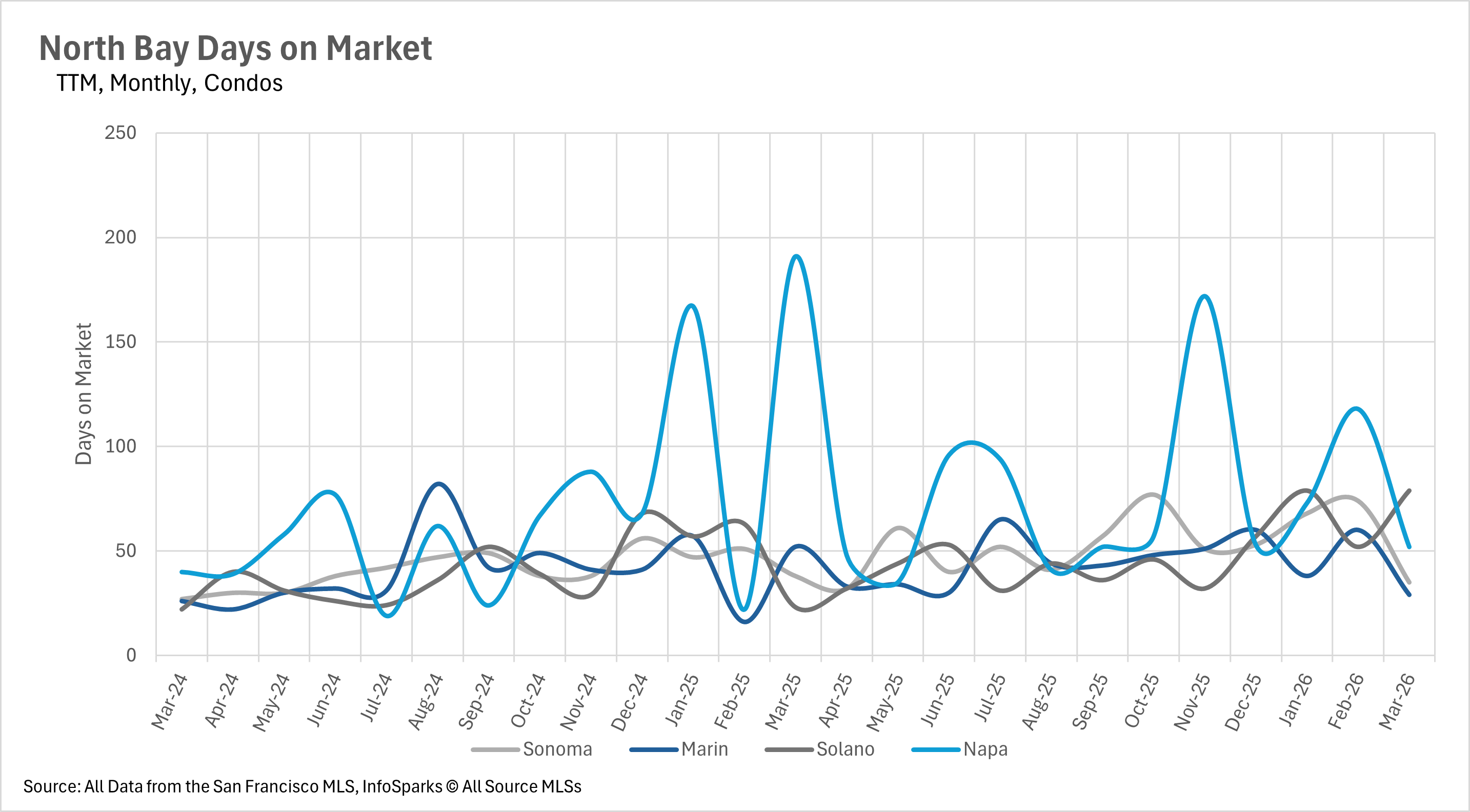
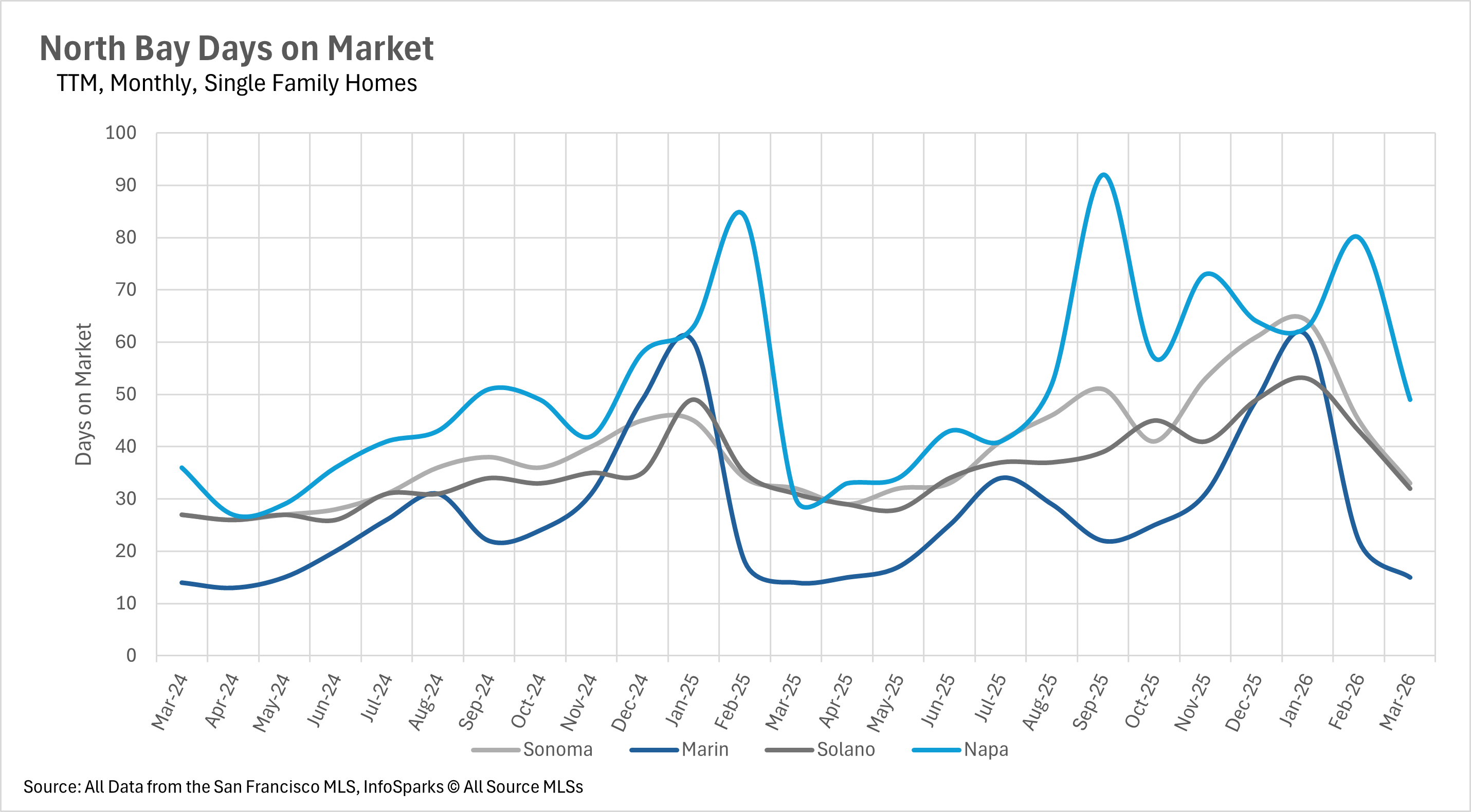
March brought a dramatic acceleration in the pace of sales across the North Bay. Single-family homes in all four counties saw significant month-over-month improvements in days on market. Napa County led the way with a 38.75% decrease, bringing the median days on market down to 49. Marin County followed closely with a 31.82% drop to just 15 days, Sonoma County improved 26.67% to 33 days, and Solano County tightened 25.58% to 32 days. On a year-over-year basis, most single-family markets are roughly in line with last year, with Sonoma and Solano Counties each up about 3% and Marin up 7.14%. Napa County is the outlier, with days on market still 63.33% higher than March 2025. The condo market saw mixed results, with Napa County condos moving 72.77% faster year-over-year while Solano County condos are taking 243.48% longer to sell.
Seller's market conditions strengthen heading into spring
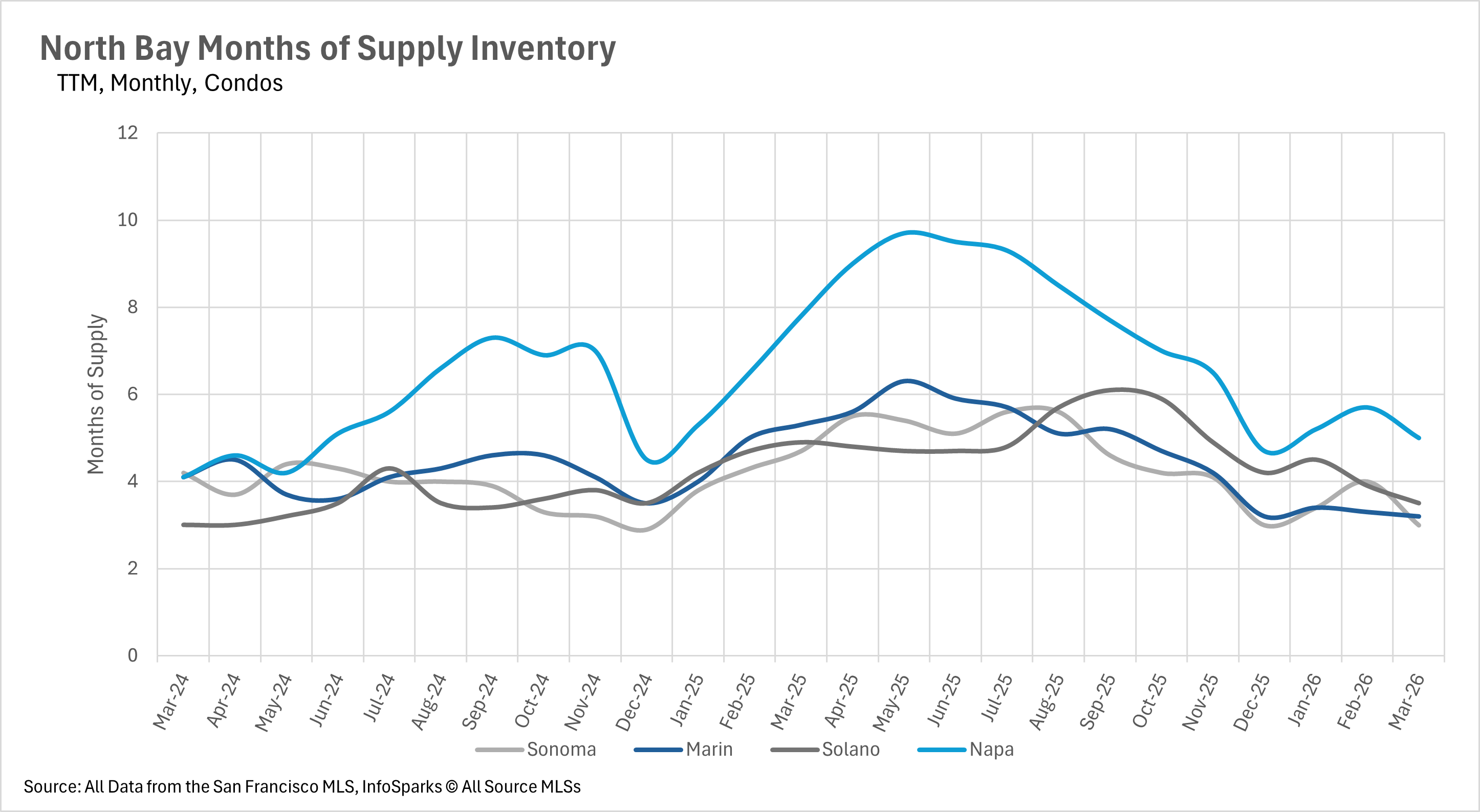
When determining whether a market is a buyers' market or a sellers' market, we look to the Months of Supply Inventory (MSI) metric. The state of California has historically averaged around three months of MSI, so any area with at or around three months of MSI is considered a balanced market. Any market that has lower than three months of MSI is considered a seller's market, whereas markets with more than three months of MSI are considered buyers' markets.
 
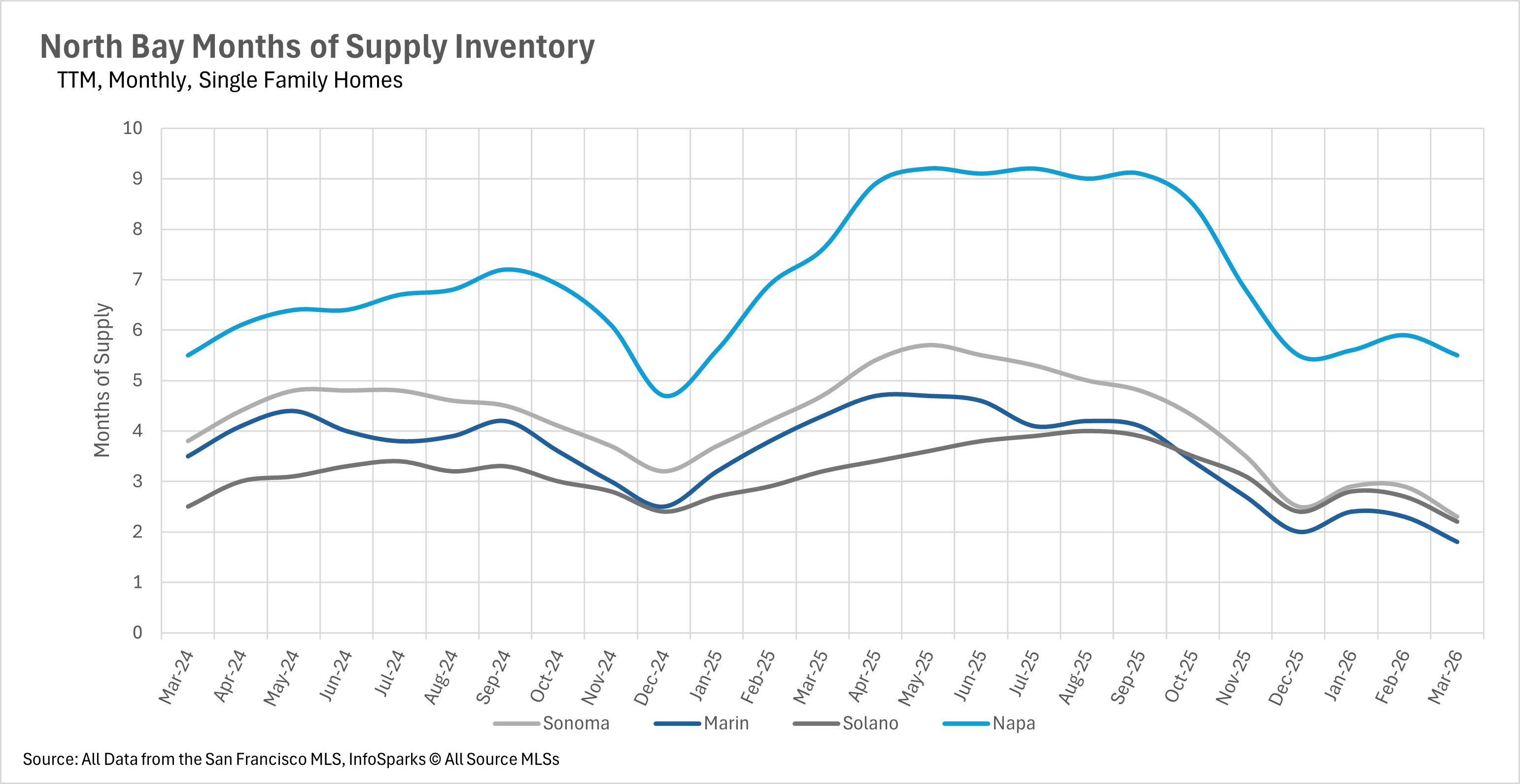
March saw inventory tighten further across the North Bay, reinforcing seller's market conditions in most segments. The single-family home market is now firmly in seller's territory in three of the four counties. Marin County has just 1.8 months of supply, down 58.14% year-over-year. Solano County sits at 2.2 months (down 31.25%), and Sonoma County has 2.3 months of supply (down 51.06%). Napa County remains more balanced at 5.5 months, though this represents a 27.63% year-over-year decline. The condo market has also continued to tighten, with Sonoma County at 3 months (down 36.17%), Marin County at 3.2 months (down 39.62%), Solano County at 3.5 months (down 28.57%), and Napa County at 5 months (down 35.90%). As we move deeper into the spring selling season, sellers continue to hold the upper hand in most North Bay markets.
Local Lowdown Data
 

ActivePipe Message ID: 3757386

Let’s Talk

You’ve got questions and we can’t wait to answer them.